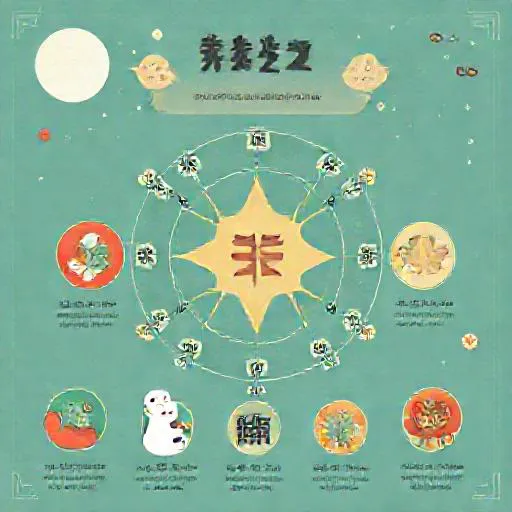
Chinese astrology bi
What Is Bazi, Exactly?
Bazi — literally "eight characters" — is a Chinese astrological system built around the exact moment you were born. Your birth year, month, day, and hour each correspond to a pair of characters drawn from the Heavenly Stems and Earthly Branches, which gives you eight characters total. Each of those characters maps to one of the five elements: Wood, Fire, Earth, Metal, and Water. Understanding the bazi five elements balance meaning starts right here, because those eight characters are basically a snapshot of how the elements were distributed at the moment you arrived.
Here's the important part: bazi isn't just about your Sun sign or a single lucky number. It's a system. The five elements interact in predictable ways — they generate one another, they control one another, they drain one another — and the whole point of reading a birth chart is to see how those interactions play out in your specific configuration. That's exactly where the bazi five elements balance meaning comes into the picture. It's not about one element being "yours" — it's about how the whole elemental distribution works together as a dynamic system.
The Core Meaning of Five Elements Balance in Chinese Astrology
When practitioners talk about the bazi five elements balance meaning, they're referring to the relative distribution of Wood, Fire, Earth, Metal, and Water in your birth chart — and whether that distribution feels harmonious or lopsided. A "balanced" chart typically has all five elements present, with no single element overwhelmingly dominant and none completely absent. An "unbalanced" chart might have three or four of one element and zero of another. This is the foundation of destiny analysis and elemental balance work in Chinese metaphysics.
But here's a nuance that gets lost in a lot of online content: balance isn't automatically "good" and imbalance isn't automatically "bad." The real bazi five elements balance meaning is about dynamics. A chart heavy in one element tells you where your natural energy concentrates — your strengths, your default reactions, your blind spots. A missing element tells you where you might feel a persistent gap, or where you unconsciously overcompensate. The yin yang balance and energy flow woven through your chart matter just as much as the raw counts.
A Quick Refresher on the Five Elements and Their Generating Cycle
Before going deeper into the bazi five elements balance meaning, let's ground the vocabulary. Each element carries a cluster of associations, and each connects to a seasonal cycle and an elemental interaction pattern:
- Wood — growth, expansion, vision, planning, flexibility. Think spring, upward momentum, and the drive to initiate. Wood feeds Fire in the generating cycle.
- Fire — expression, passion, visibility, charisma, transformation. Think summer, heat, and the impulse to shine. Fire creates Earth as ash settles.
- Earth — stability, nourishment, patience, practicality, grounding. Think late summer, harvest, and the capacity to hold things together. Earth bears Metal in the controlling cycle.
- Metal — structure, precision, boundaries, discernment, refinement. Think autumn, cutting away what's unnecessary, and the discipline to finish. Metal carries Water.
- Water — wisdom, adaptability, depth, intuition, flow. Think winter, stillness, and the ability to move around obstacles. Water nourishes Wood, completing the loop.
Each element also moves through a generating cycle (Wood feeds Fire, Fire creates Earth, Earth bears Metal, Metal carries Water, Water nourishes Wood) and a controlling cycle (Wood parts Earth, Earth absorbs Water, Water extinguishes Fire, Fire melts Metal, Metal chops Wood). Your chart's bazi five elements balance meaning emerges from how these cycles play out among your eight characters — not from any single elemental count.
Why "Balance" Isn't One-Size-Fits-All in Bazi Five Elements Balance Meaning
Here's something a lot of beginners miss: the bazi five elements balance meaning isn't about achieving a perfectly equal 20% split across all five elements. That would actually be a strange and somewhat static chart. Real balance is contextual. It depends on the season of birth, the strength of your day master (the element representing you), and what your chart actually needs to function well. This is where destiny analysis gets genuinely personal.
A practitioner — or a well-designed bazi calculator — will look at whether your day master is strong or weak, whether it has adequate support, and whether the surrounding elements nourish it or drain it. A "balanced" chart in this framework is one where your core self has what it needs to operate without being overwhelmed or starved. That's the real bazi five elements balance meaning behind the phrase — it's about energy flow, not equal percentages.
Strong Day Master vs. Weak Day Master and Elemental Support
If your day master is strong, you may benefit from elements that gently challenge or drain it — giving you outlets for all that energy. If your day master is weak, you may benefit from elements that support and reinforce it. Either way, the goal isn't to eliminate any element. It's to create flow — a chart where energy moves, cycles, and replenishes rather than stagnating or combusting. This is a core piece of the bazi five elements balance meaning that casual horoscope content tends to skip.
This is where the bazi five elements balance meaning becomes genuinely useful: it reframes "flaws" as energetic signatures. A chart overloaded with Fire isn't doomed to burnout — it's a chart whose owner benefits from deliberate grounding and cooling practices. A chart with almost no Metal isn't broken — it's a chart whose owner may need to consciously develop boundaries and structure. The elemental distribution is a map, not a verdict.
How to Read Your Own Elemental Distribution and Five Elements Balance
You don't need to hire a practitioner to get a basic read on your bazi five elements balance meaning. Most bazi calculators will give you an elemental count — something like "Wood 2, Fire 3, Earth 1, Metal 0, Water 2." From there, here's a practical way to interpret your birth chart:
1. Look at What's Dominant in Your Elemental Distribution
The element that appears most is your chart's loudest voice. It shapes your instinctive reactions, your default mode of operating, and often your most visible strengths. If Fire dominates, you likely radiate energy and seek visibility; if Water dominates, you likely think deeply and adapt fluidly. This dominant element is central to your personal bazi five elements balance meaning.
2. Look at What's Missing in Your Five Elements Balance
A missing element doesn't mean you lack that quality. It often means that quality requires more conscious effort — or that it shows up in unusual, compensating ways. A missing Earth, for instance, might translate to someone who struggles with routine but has developed creative workarounds for stability. The bazi five elements balance meaning treats missing elements as growth edges, not deficiencies.
3. Look at the Elemental Interactions, Not Just the Counts
Two elements in a generating cycle relationship behave very differently from two elements in a controlling cycle relationship. This is why raw counts alone don't tell the whole story of your bazi five elements balance meaning. A practitioner or a sophisticated calculator will factor in the elemental interactions, not just the tallies.
4. Factor in the Season of Birth and Yin Yang Balance
Your birth month carries seasonal weight. Someone born in the dead of winter has a chart shaped by Water's cold, still energy; someone born in high summer has a chart shaped by Fire's heat and activity. Seasonality adds a layer of bazi five elements balance meaning that simple elemental counts miss entirely.
What Balance (and Imbalance) Feels Like in Daily Life
Abstract theory is fine, but what does the bazi five elements balance meaning look like in practice? Here are some common patterns people recognize in themselves once they understand their birth chart and elemental profile:
- Too much Fire, not enough Water: High energy, fast pace, and a tendency to burn hot — with restlessness or irritability when things stall. Balance comes from deliberate rest, reflection, and fluidity.
- Too much Earth, not enough Wood: Reliability and groundedness, but sometimes stuckness or resistance to change. Balance comes from new initiatives, learning, and forward motion.
- Too much Metal, not enough Fire: Structure and precision, but sometimes coldness or over-criticism. Balance comes from warmth, expression, and connection.
- Too much Water, not enough Earth: Depth and adaptability, but sometimes a feeling of drift or lack of anchoring. Balance comes from routine, commitment, and grounding practices.
- Too much Wood, not enough Metal: Vision and expansion, but sometimes scattered energy or poor follow-through. Balance comes from structure, boundaries, and editing.
Notice that none of these are framed as curses. They're tendencies. The bazi five elements balance meaning is fundamentally about awareness — recognizing where your energy naturally pools and where it needs support, then working with that elemental balance instead of fighting it.
Balancing Your Elements: Practical Approaches to Five Elements Balance
Once you know your chart's leanings, what do you actually do about it? Traditional bazi practice offers several levers, and modern interpretations have expanded on them. Here are the most common approaches rooted in the bazi five elements balance meaning:
Elemental Remedies in Your Environment and Seasonal Cycle
Colors, materials, directions, and settings all carry elemental associations. If you're low on Wood, adding greenery and natural materials to your space is a classic remedy. If you're overloaded with Fire, cooler tones and calmer surroundings can help. These are subtle influences, not magic spells — but they serve as consistent environmental reminders aligned with your bazi five elements balance meaning.
Behavioral and Lifestyle Adjustments for Energy Flow
This is arguably the most powerful lever. Fire-heavy charts benefit from meditation, sleep discipline, and cooling foods. Earth-heavy charts benefit from novelty, movement, and new projects. Water-heavy charts benefit from structure, deadlines, and grounding routines. In other words, the bazi five elements balance meaning translates directly into actionable lifestyle design and better energy flow.
Timing, Decision-Making, and Destiny Analysis
Many practitioners use bazi to identify favorable periods — years or months when specific elements are strong — and align major decisions accordingly. Whether or not you buy into the predictive side of destiny analysis, the practice of pausing to consider timing before big moves has real practical value, and it ties directly back to the bazi five elements balance meaning.
Career and Collaboration Through Elemental Balance
Understanding your elemental profile can inform career choices and team dynamics. A Wood-dominant planner paired with a Metal-dominant executor covers more ground than either alone. A Fire-dominant communicator supported by a Water-dominant strategist balances visibility with depth. This is the bazi five elements balance meaning applied to real-world collaboration.
Common Misconceptions About Bazi Five Elements Balance Meaning
Before we wrap up, let's clear up a few recurring misunderstandings, because the bazi five elements balance meaning gets distorted in a lot of popular content.
- "Balanced means equal." No — balanced means functional. A chart with strong concentrations can still be well-balanced if the elements support each other constructively through the generating cycle.
- "Missing elements are bad." Missing elements are common and not inherently negative. They indicate areas where conscious development adds value to your elemental balance.
- "You can't change your chart." Your chart is fixed, but your expression of it isn't. Awareness and deliberate practice change how your elemental profile shows up in your life.
- "One element is your 'lucky' element." This oversimplifies the bazi five elements balance meaning. What you actually need depends on your day master's strength, the season of birth, and the chart's overall dynamics — not a single label.
These misconceptions are worth flagging because they turn a nuanced system into a horoscope-style shorthand. The real bazi five elements balance meaning is richer and more useful than that.
How Bazi Five Elements Balance Meaning Fits Into 2026 Life
Why is this topic surging in 2026? A few reasons. First, people are hungry for frameworks that integrate personality, timing, and environment — bazi does all three, and the bazi five elements balance meaning sits at the center of it. Second, the rise of accessible bazi calculators and well-designed apps has made something previously gatekept by specialists available to anyone with a birth time. Third, there's a broader cultural shift toward self-knowledge tools that aren't purely psychological or purely spiritual but sit somewhere in between.
The bazi five elements balance meaning also resonates because it's fundamentally non-judgmental. It doesn't tell you you're broken. It tells you you have a pattern — and patterns can be worked with. In a world of relentless self-optimization, that's a refreshing message. You're not a problem to be fixed; you're a configuration to be understood through the lens of Chinese metaphysics and elemental balance.
Getting Started Without Overcomplicating Your Five Elements Balance
If you're new to bazi, here's a simple entry point for exploring your own bazi five elements balance meaning:
- Generate your birth chart using a reputable bazi calculator (you'll need your exact birth date, time, and location).
- Note the elemental distribution and your day master.
- Read up on the strengths and challenges associated with your dominant and missing elements.
- Try one or two small lifestyle adjustments tied to what your chart suggests you need for better energy flow.
- Observe. Bazi is a lens, not a verdict — let experience refine your interpretation of your bazi five elements balance meaning.
You don't have to become an expert to benefit. Even a surface-level understanding of your elemental profile can offer genuine insight into why you operate the way you do — and where small adjustments might yield outsized improvements in your yin yang balance and overall destiny analysis.
Final Thoughts: Balance as a Verb in Bazi Five Elements Balance Meaning
The deepest takeaway from the bazi five elements balance meaning is that balance isn't a state you achieve once and then forget about. It's a verb. Your chart shows your starting configuration — the terrain you're working with — but the ongoing work of balancing is yours to do. Feed the elements that need support, temper the ones that run hot, and respect the ones that come naturally. That's not superstition. That's self-awareness with a structured vocabulary, which is exactly why the bazi five elements balance meaning continues to resonate with thoughtful people in 2026 and beyond.
Whether you treat it as a metaphysical tradition, a personality framework, or just a fascinating lens on human variation, the five elements offer something genuinely valuable: a way to see yourself as a dynamic system rather than a fixed set of traits. And that, more than any prediction, is the real bazi five elements balance meaning — balance as an ongoing practice, not a one-time score.