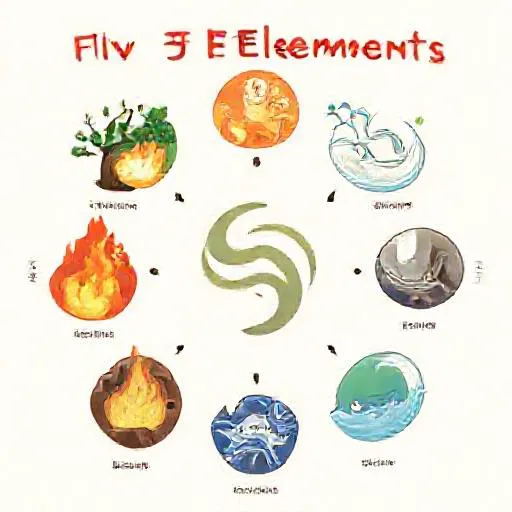
Five phases of Wu Xi
What Are the Five Elements, Exactly?
The five elements meaning in Chinese metaphysics starts with a surprisingly simple list: Wood, Fire, Earth, Metal, and Water. In Chinese tradition, this system is called Wu Xing, which translates roughly to "five phases" or "five movements." Notice the word "phases" instead of "elements" — that distinction is a big deal. Unlike the ancient Greek idea of static substances (earth, air, fire, water) that things are supposedly made of, the Chinese framework treats these five as dynamic states of change and transformation. They're processes, not stuff. Everything is constantly shifting from one phase to another, and the five elements meaning in Chinese metaphysics maps out exactly how that shift happens.
That's why so many scholars and practitioners prefer saying "five phases." A tree isn't just "wood" — it's in a wood phase of growth and expansion. A flame isn't just "fire" — it's in a fire phase of rising and radiating. Grasping this dynamic quality is the first real key to understanding the five elements meaning in Chinese metaphysics.
Wood, Fire, Earth, Metal, and Water: Core Symbolism and Energetic Qualities
Let's walk through each one. For every element, I'll cover its core symbolism, its associated qualities, and how it tends to show up in a birth chart or environmental reading.
Wood (Mu) represents the energy of spring, of things pushing upward and outward. Picture a seedling breaking through soil — that's the essence of wood energy. In the five elements meaning in Chinese metaphysics, wood is tied to the East, the spring season, the color green, and the liver and gallbladder in traditional medicine frameworks. Emotionally, it's linked to anger when imbalanced and kindness when balanced. Its qualities include vision, planning, creativity, flexibility, and the drive to grow. Someone with strong wood energy is often a natural planner, a visionary, or someone who thrives on starting new projects. When wood is excessive or blocked, you'll see frustration, rigidity, or an inability to let go.
Fire (Huo) is the energy of summer, of peak activity and maximum expression. It's the phase where things bloom, radiate, and connect. Fire corresponds to the South, the summer season, the color red, and the heart and small intestine. Emotionally, it's joy when balanced and overexcitement or anxiety when imbalanced. Its qualities are passion, charisma, sociability, transformation, and spiritual awareness. Fire-heavy individuals tend to be warm, expressive, and magnetic — they light up a room. But too much fire can lead to burnout, impulsiveness, or emotional volatility. Fire is also the element most associated with visibility and recognition — it's the energy of being seen.
Earth (Tu) sits at the center of the five-element cycle in many diagrams, and that's fitting. Earth represents the transitional phases between seasons, the moments of stillness and centering. It's the element of the soil that nourishes everything. Earth associations include the Center, late summer and seasonal transitions, the colors yellow and brown, and the spleen and stomach. Emotionally, it's worry when imbalanced and empathy and thoughtfulness when balanced. Its qualities are reliability, patience, nurturing, practicality, and groundedness. Earth energy is the glue that holds things together. People with strong earth are the dependable ones — the friends who show up, the colleagues who follow through. When earth is weak, you might see boundary issues, overthinking, or a sense of being ungrounded.
Metal (Jin) is the energy of autumn — the harvest, the cutting away of what's no longer needed, the refinement of raw material into something precise. In the five elements meaning in Chinese metaphysics, metal links to the West, the autumn season, the color white and metallic tones, and the lungs and large intestine. Emotionally, it's grief when imbalanced and integrity and righteousness when balanced. Its qualities include discipline, clarity, structure, efficiency, and the ability to let go. Metal types are often organized, principled, and decisive. They value quality over quantity and have a natural knack for setting boundaries. Excessive metal shows up as perfectionism or coldness, while deficient metal might manifest as difficulty with closure.
Water (Shui) is the energy of winter — stillness, depth, conservation, and the storage of potential. It's the most yin of the five elements, associated with introspection and inner knowing. Water corresponds to the North, the winter season, the colors black and deep blue, and the kidneys and bladder. Emotionally, it's fear when imbalanced and wisdom and courage when balanced. Its qualities are adaptability, intelligence, intuition, and the ability to flow around obstacles. Water-dominant people tend to be deep thinkers, highly intuitive, and remarkably adaptable. When water is out of balance, you might see excessive fear, isolation, or a tendency to drift.
The Generating and Controlling Cycles: How the Five Phases Interact in Balance
Here's where the five elements meaning in Chinese metaphysics gets really interesting. The elements don't exist in isolation — they're defined by their relationships with each other. There are two primary cycles describing these relationships.
The Generating Cycle (Sheng) is the creative, nourishing cycle. Each element feeds and supports the next: Wood feeds Fire (wood burns to create flame), Fire creates Earth (ash becomes soil), Earth creates Metal (minerals form within the earth), Metal creates Water (condensation forms on metal surfaces), and Water creates Wood (water nourishes plant growth). In a birth chart or environmental analysis, the generating cycle shows where support is coming from. If your chart is weak in fire, a practitioner might look at whether wood energy is present to "feed" it.
The Controlling Cycle (Ke) is the regulating, balancing cycle. Each element keeps another in check: Wood controls Earth (roots break up soil), Earth controls Water (soil absorbs and directs water), Water controls Fire (water extinguishes flame), Fire controls Metal (heat melts metal), and Metal controls Wood (an axe cuts wood). The controlling cycle isn't about destruction — it's about balance. Without it, any single element would run unchecked and throw the whole system out of harmony. Skilled practitioners read both cycles together to understand a person's strengths, challenges, and ideal directions for growth.
BaZi, Feng Shui, Traditional Medicine, and Coaching: Real-World Applications
The five elements meaning in Chinese metaphysics isn't just theoretical. It's applied across a wide range of disciplines. In BaZi (Four Pillars of Destiny), a person's birth date and time are mapped into a chart of heavenly stems and earthly branches, each associated with an element. A practitioner reads the balance of elements to understand personality tendencies, life patterns, and favorable directions. It remains one of the most detailed applications of five-element theory and is still widely practiced in 2026.
In feng shui — the traditional practice of arranging spaces for harmony — the five elements are used to adjust the energy of a home or workplace. If a space feels overly active and fire-heavy, a consultant might introduce water or earth elements to balance it. Colors, materials, shapes, and even object placement are all chosen with elemental qualities in mind. This is where the five elements meaning in Chinese metaphysics becomes something you can literally walk through.
Traditional East Asian medicine uses the five elements to understand the body. Each element links to specific organs, emotions, and seasonal tendencies. A practitioner might attribute certain health patterns to elemental imbalances — excess fire manifesting as insomnia or irritability, or deficient earth showing up as digestive issues. Wellness routines such as diet, movement, and rest are often tailored to a person's elemental constitution.
In recent years, there's been growing interest in using five-element frameworks for personal growth. Coaches and self-development practitioners draw on the system to help people understand their natural strengths, recognize patterns of imbalance, and design routines that support their elemental needs. It's a refreshingly holistic alternative to one-size-fits-all productivity advice.
Everyday Elemental Balance: Identifying Dominant Elements and Seasonal Routines
You don't need to be a seasoned practitioner to benefit from the five elements meaning in Chinese metaphysics. Here are a few practical ways to start. First, identify your dominant and deficient elements by reflecting on your tendencies. Are you naturally driven and visionary (wood)? Warm and expressive (fire)? Steady and dependable (earth)? Precise and principled (metal)? Introspective and adaptable (water)? Most people have one or two dominant elements and one or two that feel underdeveloped. A birth chart reading from a qualified practitioner can give you a more precise picture.
Second, balance your environment. Look around your living or working space. Does it feel cluttered and stagnant (wood deficiency)? Overly sharp and cold (metal excess)? Too dark and still (water dominance)? Introducing colors, textures, and materials associated with the missing elements can subtly shift the mood of a room. Small changes — a plant, a warm textile, a bowl of stones — can make a noticeable difference.
Third, adjust your routines to the seasons. The five elements map beautifully onto the seasons. In spring, lean into wood energy — start new projects, get moving, plan ahead. In summer, embrace fire — socialize, express yourself, enjoy the heat. In autumn, channel metal — organize, declutter, let go of what's finished. In winter, honor water — rest, reflect, conserve your energy. During seasonal transitions, ground yourself with earth energy.
Fourth, use elements to manage emotional patterns. Each element corresponds to a core emotion. If you notice chronic frustration (wood imbalance), excessive worry (earth imbalance), or persistent fear (water imbalance), you can use balancing practices associated with the controlling cycle. Metal's clarity and structure can help cut through earth's tendency to overthink. Water's calm depth can soothe fire's anxiety. It's a simple but surprisingly effective self-awareness tool rooted in the five elements meaning in Chinese metaphysics.
Common Misconceptions About Wu Xing and Elemental Harmony
Before we wrap up, let's clear up a few things that often trip people up. Misconception 1: More of your dominant element is always good. Actually, excess in any element creates imbalance. The goal is harmony, not maximization. A chart with balanced elements is generally considered more stable than one that's heavily skewed. Misconception 2: The five elements are literal substances. They're phases or qualities of energy, not physical materials. "Fire energy" doesn't mean literal fire — it means the qualities of expansion, visibility, and transformation. Misconception 3: Your element type is fixed for life. While your birth chart is set, the dynamic nature of the five elements means your expression of them can shift over time based on your environment, choices, and life stage. Misconception 4: It's just superstition. The five elements meaning in Chinese metaphysics is a sophisticated system of pattern recognition that has informed everything from medicine to architecture across East Asia. Whether or not you embrace it spiritually, it offers a rich metaphorical vocabulary for understanding balance, change, and human behavior.
In a world that feels increasingly complex and fast-moving, the five elements meaning in Chinese metaphysics offers something valuable: a framework for understanding balance. It reminds us that growth (wood) needs to be tempered with structure (metal), that passion (fire) needs grounding (earth), and that wisdom (water) often emerges from stillness. Whether you're exploring birth chart analysis, designing a more balanced home, refining your wellness routine, or simply curious about a tradition that has endured for millennia, the five elements provide a remarkably practical and poetic lens. Start by noticing the elements around you and within you — the five elements meaning in Chinese metaphysics might just surprise you with how much clarity this ancient framework brings to modern life.